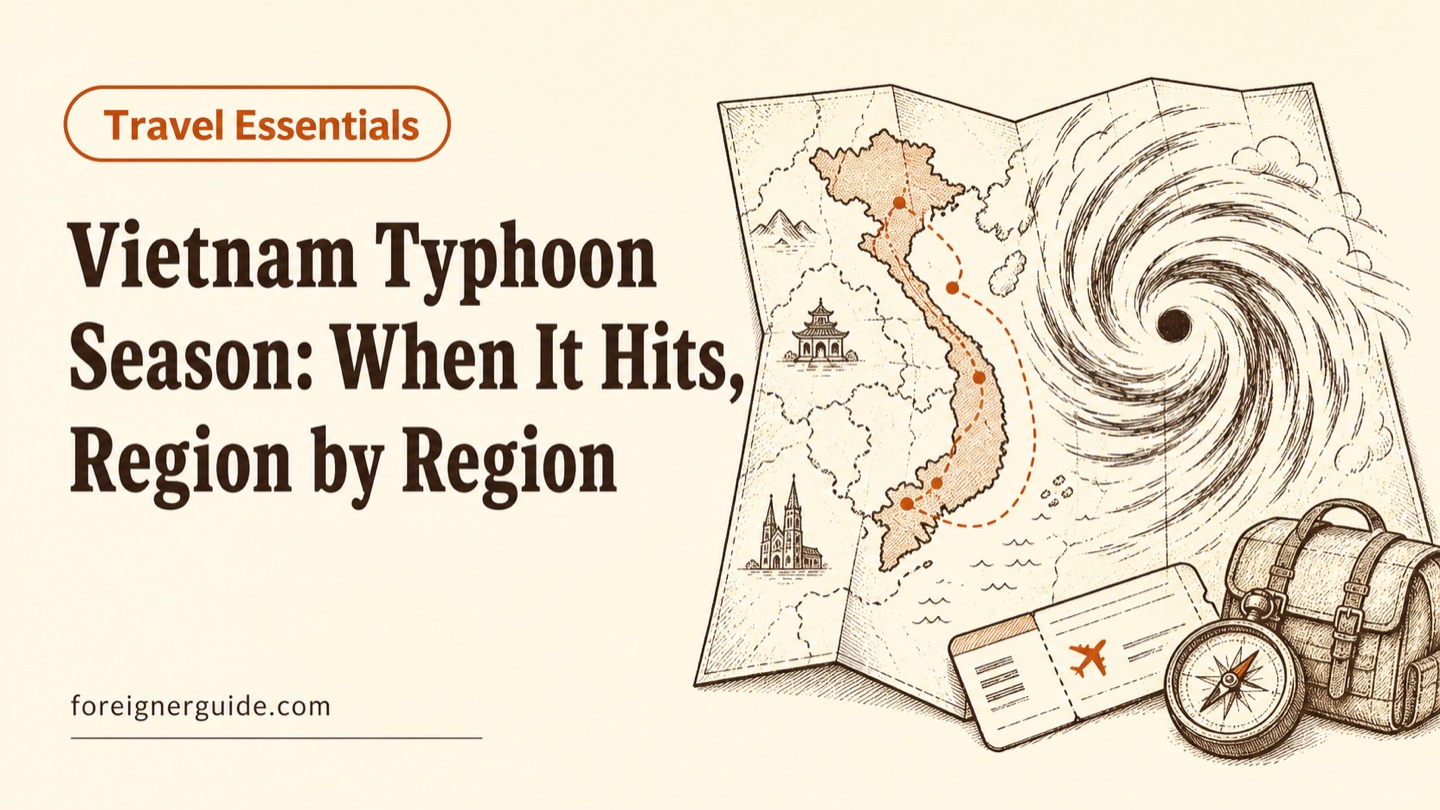
Vietnam Typhoon Season: When It Hits, Region by Region
Vietnam's typhoon season runs June to November, with the central coast most at risk from September. Here's the timing by region and how to plan around it.
Table of contents
Vietnam's typhoon season runs roughly from June through November, and the risk shifts down the coast as the months pass. As of mid-2026, the general pattern described by the National Center for Hydro-Meteorological Forecasting (NCHMF), Vietnam's official weather agency, is that northern Vietnam sees more storms early in the season, the central coast around Da Nang and Hue takes the heaviest landfalls from about September to November, and the far south rarely gets a direct hit. The practical takeaway for a trip: most travel goes ahead normally, but a single storm can close beaches, ground flights, and flood a city for a few days.
This guide explains the seasonal pattern for travelers and residents on the Vietnamese mainland, and how to check for real storms. It is not a live forecast, so always look at an official source in the days before you go. If you are still choosing dates, it fits alongside the wider timing questions covered in how to plan a trip abroad.
When is typhoon season in Vietnam?
The active period runs from June to November, with the strongest months usually August through October. According to NCHMF, about 11 to 13 tropical cyclones enter the East Sea (Vietnam's name for the South China Sea) in a typical year, and roughly 4 to 6 of them make landfall or directly affect the mainland. So most storms that form never reach the coast, but the ones that do can arrive fast.
Vietnam does not forecast these storms alone. NCHMF tracks systems in the East Sea together with the Japan Meteorological Agency (JMA) and the U.S. Joint Typhoon Warning Center (JTWC), which is why you will often see slightly different storm names and forecast tracks in the news. A tropical storm can strengthen into a typhoon in a day or two once it is over warm water, so a forecast made a week out is far less reliable than one made 48 hours before landfall.
Which regions get hit, and when?
Timing is not uniform across the country, and that matters more than the season dates. Northern Vietnam is more exposed earlier in the season. The central coast carries the heaviest typhoon, heavy-rain, and flood risk in its September-to-November peak. The south, closer to the equator, sees plenty of rain but few direct strikes.
| Region | Main areas | Higher-risk months |
|---|---|---|
| North | Hanoi, Ha Long Bay, Hai Phong | June to August |
| Central | Da Nang, Hoi An, Hue, Nha Trang | September to November |
| South | Ho Chi Minh City, Mekong Delta, Phu Quoc | Direct hits rare; heavy rain May to November |
A concrete example shows why the central coast deserves the most caution. Typhoon Kalmaegi made landfall in central Vietnam on November 6 and 7, 2025, affecting Da Nang, Quang Ngai, Khanh Hoa, and Dak Lak; news agencies including Al Jazeera reported that more than 500,000 people were evacuated. If your dates fall in the autumn window, treat Da Nang, Hoi An, and Hue as the places most likely to see a disruption, and keep your plans there flexible.
How do I check for storms before and during a trip?
Check an official forecast source, not a travel blog, in the three to five days before you move. NCHMF publishes storm bulletins and warnings at nchmf.gov.vn. Its warnings use a color-coded disaster risk scale that is worth recognizing, because Vietnamese news and local authorities use the same levels:
- Level 1 - blue (low risk)
- Level 2 - yellow (moderate risk)
- Level 3 - orange (high risk)
- Level 4 - red (very high risk)
- Level 5 - purple (disaster)
For traveler-facing alerts in English, the U.S. Embassy in Vietnam issues weather notices during major storms and recommends enrolling in the Smart Traveler Enrollment Program (STEP) at travel.state.gov, which sends free email alerts for the country and dates you choose. Citizens of other countries can look for the equivalent service from their own foreign ministry. On the ground, follow the instructions of local authorities and your accommodation over any online tracker.
Planning a trip around the season
You do not need to avoid Vietnam from June to November. You do need buffer room. Build one or two spare days into any tight itinerary that runs along the central coast in September, October, or November, so a two-day closure does not wreck a connecting flight or a booked tour. Choose accommodation and tour operators with clear, written cancellation terms, and pay in a way you can dispute if a trip is called off.
Travel insurance that covers weather disruption and medical care is the other piece. Read the policy for how it treats named storms, because some plans stop covering a typhoon once it has been officially named. For longer stays and residents, the wider question of coverage abroad is covered in health insurance for expats. If a beach stay is the whole point of the trip, the drier south, including Phu Quoc, is a safer bet than the central coast in peak months.
One more timing note if you shift a trip toward the drier months: Tet, the Vietnamese Lunar New Year, falls on February 6, 2027. The official break usually lasts about a week, which for 2027 points to closures roughly from February 5 to 11 — trains, flights, and hotels sell out well ahead, and many businesses shut for several days. Vietnam's government confirms the exact holiday dates only a few months in advance, so treat that window as expected rather than final. Tet shifts with the lunar calendar and weather varies by region, so re-check both the holiday dates and the seasonal picture for the year you actually travel.
What to do if a storm is heading your way
Once a warning is issued for your area, keep it simple. Move indoors and stay off beaches, boats, and coastal roads, since sea conditions turn dangerous well before the storm arrives. Charge your phone and a power bank, fill a few water bottles, and keep some cash on hand, because power and card systems can drop for a day or more. Keep your passport and a printed copy of your bookings in a dry, sealed bag. If your flight is cancelled, contact the airline directly rather than joining the crowd at the airport counter. Most typhoons pass within a day or two, and the disruption is usually short even when it is intense.