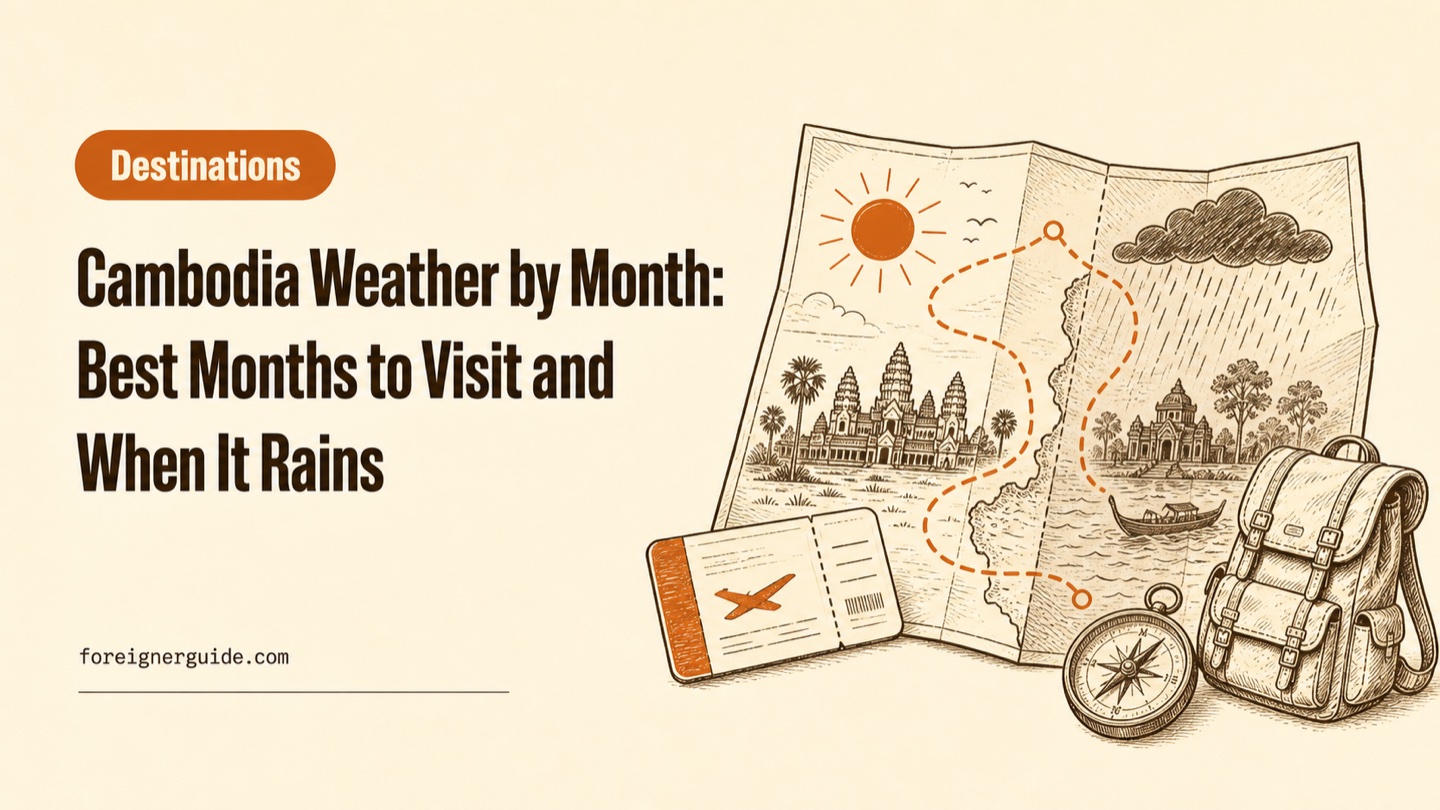
Cambodia Weather by Month: Best Months to Visit and When It Rains
Cambodia's dry season runs mid-November to April, the wet monsoon May to mid-November. November to February is coolest and driest — the best time to visit.
Table of contents
Cambodia runs on two seasons: a dry stretch from roughly mid-November through April, and a wet southwest monsoon from May into mid-November. For the most comfortable travel weather, aim for November to February, when the air is cooler and rain is rare. March and April turn hot, and September and October bring the heaviest rain. As of July 2026 that pattern still holds. According to Encyclopaedia Britannica, daytime highs climb from about 28°C in January, the coolest month, to around 35°C in April, the hottest.
This guide covers the lowland areas most travelers visit - Phnom Penh, Siem Reap and the Angkor temples, plus a note on the coast - for general trip planning. It describes typical monthly patterns, not a day-by-day forecast, so treat any single week as a rough guide.
Dry season versus wet season: how the weather works
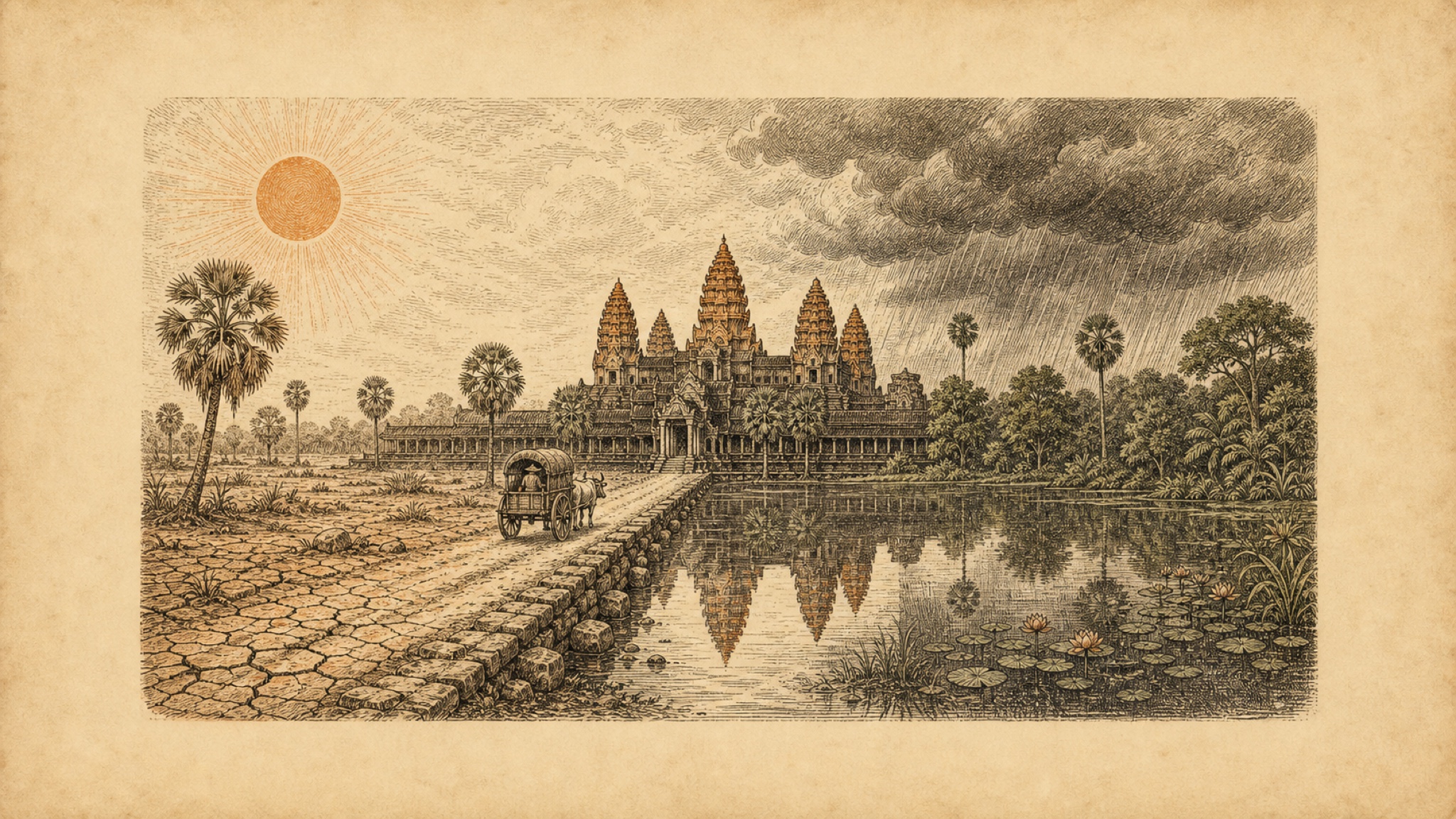
Cambodia has a tropical monsoon climate. That means hot all year, with rain bunched into one half of the calendar. The southwest monsoon delivers most of the country's rain from May to mid-November, and the drier northeast monsoon takes over from November through April. Within that cycle, the hottest stretch runs from roughly March to May, with April the peak, and the heaviest monsoon rain falls between June and October, sometimes into November. Climate references put the bulk of annual rainfall, roughly 80 to 90 percent, in those wet months.
The totals are smaller than the tropics suggest. Phnom Penh averages around 1,400 mm of rain a year, and Siem Reap, next to Angkor, around 1,470 mm - but almost all of it falls between May and October. Temperature barely swings. Daytime highs sit in the low-to-mid 30s Celsius nearly every month, so "cool" here means overnight lows in the low 20s during December and January, not a real winter.
Cambodia weather month by month
Here is how a typical year looks in Phnom Penh, which sits in the central lowlands and tracks close to Siem Reap. The figures are long-term averages for daytime highs and overnight lows; real days vary.
| Month | High (°C) | Low (°C) | Rain and season |
|---|---|---|---|
| January | 31 | 23 | Dry, coolest and driest |
| February | 33 | 23 | Dry, warming up |
| March | 34 | 25 | Dry, hot and dusty |
| April | 35 | 26 | Dry, hottest month |
| May | 35 | 26 | Wet begins, short downpours |
| June | 34 | 26 | Wet, hot |
| July | 33 | 26 | Wet, showers build |
| August | 33 | 25 | Wet, steadier rain |
| September | 32 | 25 | Wet, very rainy |
| October | 31 | 25 | Wet, wettest, flood risk |
| November | 31 | 24 | Dry returns |
| December | 30 | 23 | Dry, cool evenings |
A few things to read from the table. December and January are the sweet spot: dry, with mornings in the low 20s. February warms up, and by March and April the heat builds past 35°C, which makes April the hardest month for long days among the temples. The first rains in May and June arrive as short afternoon downpours that clear quickly. From August the rain gets steadier, and September and October carry the heaviest totals - Siem Reap's wettest month averages close to 286 mm, most of it in September.
When is the best time to visit Cambodia?
November to February is the most reliable window. The rain has stopped, humidity eases, and daytime highs settle around 30 to 32°C with cooler evenings - the easiest conditions for walking Angkor Wat or exploring Phnom Penh. This is also peak tourist season, so flights and hotels cost more and the famous temples fill up at sunrise.
The transition out of the wet season carries one of the country's biggest events. Bon Om Touk, the water festival, marks the reversal of the Tonlé Sap River's flow with boat races and fireworks along the Phnom Penh riverside. It follows the November full moon, and travel calendars list November 23 to 25 for 2026. If you go then, book a room early, because the capital gets crowded.
One more date is worth planning around, and it falls in April. Khmer New Year, or Choul Chnam Thmey, is the country's biggest holiday; Office Holidays lists the 2027 dates as April 14 to 16. Much of the population travels home for it, so many businesses and some services close for several days, while Siem Reap and Angkor draw a surge of domestic visitors. It lands in the hottest part of the year, and the dates can shift slightly from year to year, so re-check both the forecast and the holiday dates for your travel year.
For Angkor specifically, budget for the entrance pass whichever month you pick. The official ticket seller, Angkor Enterprise, lists a one-day pass at US$37, a three-day pass at US$62, and a seven-day pass at US$72 as of July 2026; you can check current prices and buy online at angkorenterprise.gov.kh.
Is the rainy season a bad time to travel?
Not necessarily. The wet season has real upsides - greener landscapes, thinner crowds, and lower prices - and the rain often falls in one heavy burst rather than all day. May through July stays hot with scattered downpours you can plan around. From August into October the rain turns more constant and can flood low-lying streets and rural roads, with the risk highest in October and November.
The coast is a different story. Climate records put Koh Kong in the southwest above 4,000 mm of rain a year, several times Phnom Penh's total, so beach plans around Sihanoukville or Koh Rong are safer in the dry months from November to April.
What to pack and how to plan around the weather
The heat is the constant, not the rain, so pack for warmth first:
- Lightweight, breathable clothing for 30 to 35°C days, plus one light layer for cool December evenings and cold air-conditioned buses.
- Sun protection and a refillable water bottle year-round.
- A compact rain jacket or travel umbrella if you travel July through October, and quick-dry shoes for flooded streets.
- Modest clothing that covers shoulders and knees for temple visits - the Angkor dress code applies in every season.
Because Cambodia's best-weather months overlap with the busiest travel season, lock in flights and rooms well ahead; our guide to planning a trip abroad walks through timing, documents, and budgeting. Phone signal is patchy around the temple complex, so it helps to download offline maps before you arrive, which using Google Maps for travel covers step by step.