How to Open a Bank Account Abroad Before and After You Move
Opening a bank account abroad usually needs a passport, proof of address, and a tax number, but digital accounts like Wise let you start before you arrive.
Table of contents
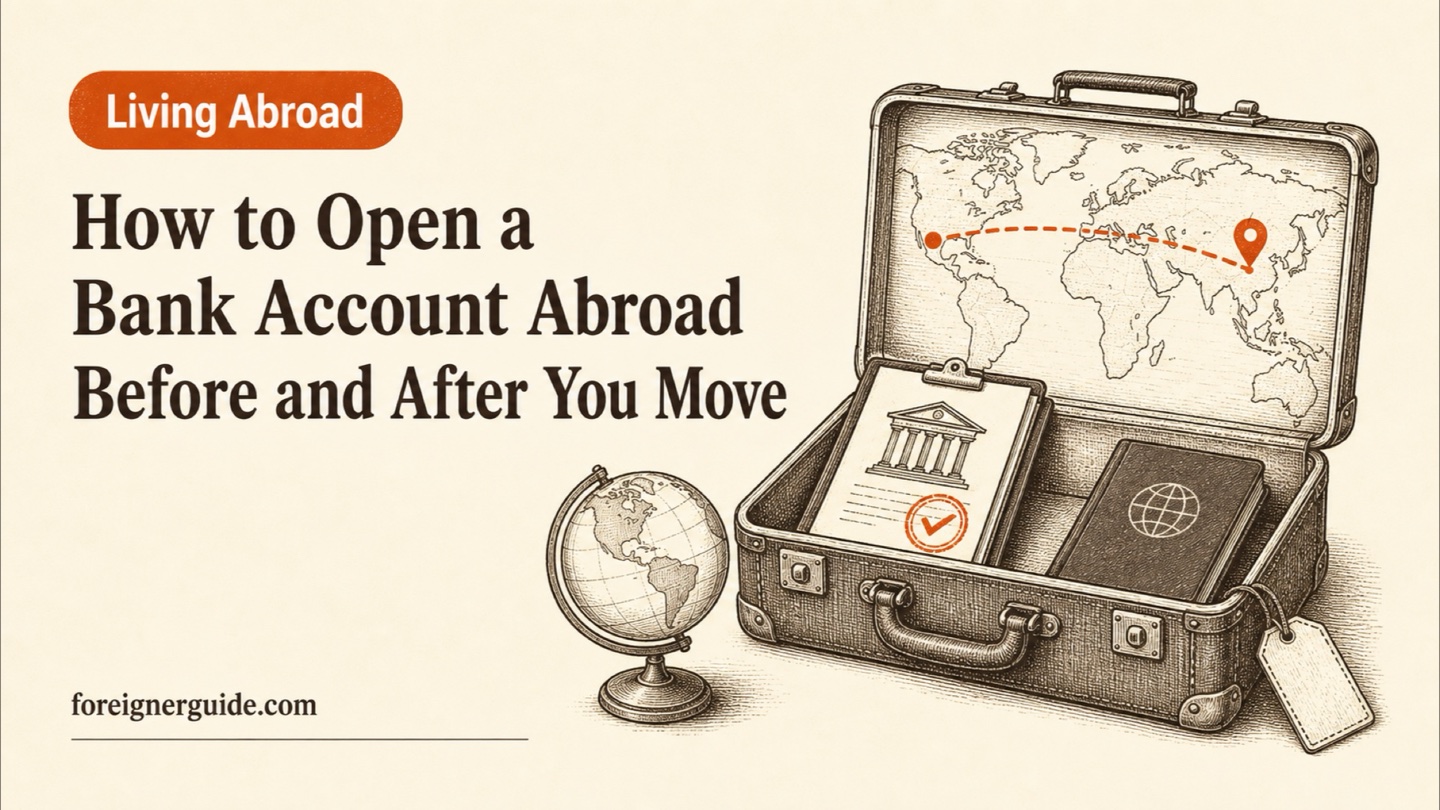
Opening a bank account abroad comes down to three things: proving who you are, proving where you live, and giving a tax number. As of July 2026, most established banks ask a foreigner for a valid passport, a recent proof of address such as a utility bill, and a local tax identification number before they open an account, and money apps like Wise publish the same short checklist on their own sites. If you have not arrived yet, or your paperwork is not ready, digital multi-currency accounts such as Wise, Revolut, and N26 let you hold and move money in the meantime, often with just an ID and a quick video check. This guide covers personal accounts for travelers, new residents, and remote workers; it is general information rather than legal or tax advice, and the exact rules depend on your country and bank.
What documents do you need to open a bank account abroad?
In most places you need three things: photo identification, proof of where you live, and a tax number. A valid passport is the one document almost every bank accepts, and many also ask for a second form of ID such as a national identity card or a driver's license. For proof of address, banks usually want a recent utility bill for water, gas, or electricity, or a statement from another bank, dated within the last few months.
The tax number is what trips up newcomers most often. Many countries expect a local tax identification number (TIN), sometimes issued automatically when you register your residency and sometimes through a separate application. In the United States, a foreigner without a Social Security number can apply for an Individual Taxpayer Identification Number (ITIN), a tax ID for people who need to be reported to the tax office but do not qualify for an SSN. Some banks also ask for a visa or residence permit before they will open an account, and a few request proof of income such as a work contract or recent payslips.
| Document | Example | Why the bank asks |
|---|---|---|
| Photo ID | Passport or national ID card | Confirms your identity |
| Proof of address | Recent utility bill or bank statement | Shows where you live |
| Tax number | Local TIN, or an ITIN in the US | Used for tax reporting |
| Residence document | Visa or residence permit | Often required before opening |
Requirements shift from country to country, and even between branches of the same bank, so it pays to call ahead or check the bank's website before you visit.
Digital accounts you can open before you arrive
Digital multi-currency accounts let you sign up remotely, usually before you have a local address or a permanent home. A multi-currency account is one that can hold and convert several currencies in the same place, which helps when your income and your rent are in different money. According to their own pages, Wise, Revolut, and N26 all let you open a personal account from a phone using an ID and a short identity check.
The details differ by provider. Wise states that signup is free with no monthly fee, that an account can hold more than 40 currencies, and that verification usually takes around one working day. Revolut says people in about 40 countries and 10 overseas territories can register, with identity confirmed by uploading a government ID and recording a live video selfie in the app. N26 lists roughly two dozen European countries where its euro account is available and notes that you need a mailing address in a supported country to receive its card.
| Provider | Where it operates | How signup works |
|---|---|---|
| Wise | Many countries worldwide | ID and proof of address; free, no monthly fee |
| Revolut | About 40 countries plus territories | ID upload and a live video selfie in the app |
| N26 | Around two dozen European countries | ID check plus a mailing address in a supported country |
These accounts are good for landing money, paying for things, and moving funds across borders. Whether they fully replace a local bank depends on your situation, because some landlords and employers still want a domestic account number, and cash deposits can be harder with an app-only provider. You can check current terms and country coverage on Wise's site.
Opening a local bank account, step by step
When you do open an account with a bank in your new country, the path is fairly consistent. Most in-person openings follow this order:
- Choose a bank and an account type that fit your status, since some banks have specific accounts for newcomers or non-residents.
- Gather your documents: passport, proof of address, tax number, and any residence permit.
- Book an appointment or start online, depending on the bank; several countries still require at least one in-person visit.
- Complete identity verification and sign the account agreement.
- Make any required opening deposit, then wait for your card and account details, which can take a few days to a couple of weeks.
Opening deposits vary widely. Some accounts have no minimum at all, while others ask you to fund the account before it goes live, so confirm the amount before your appointment rather than assuming.
Do you have to report a foreign account back home?
If you are a US citizen or resident, you may have to, even if you live abroad and the account is only for daily spending. The US Treasury's Financial Crimes Enforcement Network (FinCEN) requires US persons to file a Report of Foreign Bank and Financial Accounts, known as the FBAR, when the combined value of their foreign accounts tops 10,000 US dollars at any point in the calendar year. FinCEN and the IRS explain that this is filed electronically as FinCEN Form 114, separately from your tax return, and that the deadline is April 15 with an automatic extension to October 15.
The threshold is based on the total across all your foreign accounts, not each one, so even a brief rise above 10,000 dollars can trigger the filing. Citizens of other countries have their own rules, and under the OECD's Common Reporting Standard many banks automatically share account information with tax authorities across borders. Because reporting duties depend on your citizenship and residence, confirm your own situation with the relevant tax authority. You can read the official FBAR requirements on FinCEN's website.
Common snags that slow people down
The most common holdup is proof of address. If you have just arrived and your name is not yet on a lease or a utility bill, some banks will turn you away, while others accept a rental contract, an employer letter, or a residence registration instead. Ask which alternatives a bank allows before you rule it out.
A few other issues come up regularly. Many banks in Europe and Asia still require an in-person appointment, so remote-only openings are not always possible. App-based accounts can limit cash deposits, which matters if you get paid or tipped in cash. And converting your home currency into local money through a traditional bank often costs more than a specialist transfer service, so compare the rate before you move a large sum.
With a passport, a clear proof of address, and a tax number in hand, most travelers and new residents can open a working account within a couple of weeks, and a digital multi-currency account can carry you through the gap in the meantime.